
Building your dream home in Kerala is one of the biggest investments you’ll ever make. From selecting flooring and paint colors to planning wardrobes and modular kitchens, every decision affects how your home looks and performs over the years.
Yet, one of the most overlooked decisions is choosing the right board material.
Walk into any interior showroom, and you’ll hear terms like Plywood, MDF, HDHMR, and WPC. Every salesperson claims their product is the best. One says plywood lasts forever, another recommends HDHMR, while someone else insists WPC is waterproof.
So, which one should you actually choose?
The truth is that there is no single material that’s perfect for every application. Each has its own strengths, weaknesses, price range, and ideal use cases. Choosing the wrong one can lead to swelling, warping, termite damage, or unnecessary expenses.
This guide explains everything in simple language so that homeowners can make informed decisions before investing in interiors.
Why Material Selection Matters More in Kerala
Kerala has one of India’s most challenging climates for furniture and interiors.
Throughout the year, homes experience:
- High humidity
- Heavy monsoon rains
- Moisture in walls
- Coastal salt air in many districts
- Occasional termite attacks
- Warm temperatures
Unlike dry climates where almost any engineered wood performs well, Kerala’s weather demands materials that can withstand moisture over many years.
A wardrobe that works perfectly in Rajasthan may start swelling within months if installed in a humid coastal home without proper material selection.
That’s why professional interior designers never recommend using a single material throughout the house.
Instead, they select different materials based on where they’ll be used.
Understanding the Four Most Popular Interior Materials
Let’s first understand what each material actually is.
1. Plywood
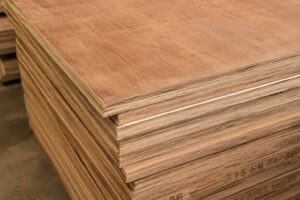
Plywood is made by bonding multiple thin layers of natural wood veneers together.
Each layer is placed perpendicular to the previous one, making the board extremely strong and dimensionally stable.
The adhesive used determines whether the plywood is suitable for moisture-prone areas.
Common grades include:
- MR Grade
- BWR Grade
- BWP Marine Grade
Among these, BWP Marine Plywood is the preferred choice for Kerala kitchens and moisture-prone interiors.
Advantages
- Excellent strength
- Long lifespan
- Holds screws firmly
- Resistant to bending
- Available in multiple thicknesses
- Can support heavy loads
Limitations
- More expensive than MDF
- Quality varies by manufacturer
- Needs proper edge finishing
- Lower grades are vulnerable to moisture
2. MDF (Medium Density Fiberboard)
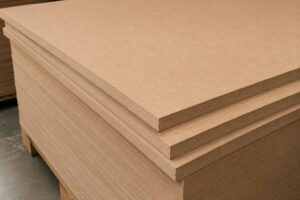
MDF is manufactured by compressing fine wood fibers with resin under high pressure.
Instead of wood layers like plywood, MDF has a smooth, uniform core.
This makes it ideal for decorative finishes.
Advantages
- Extremely smooth surface
- Perfect for PU painting
- Excellent for CNC cutting
- Affordable
- Uniform finish
- No wood grains
Limitations
- Weak against moisture
- Swells when exposed to water
- Poor screw holding
- Heavy compared to plywood
- Not suitable for kitchens in humid regions
For Kerala homes, MDF should mainly be used in dry indoor spaces.
3. HDHMR (High Density High Moisture Resistant Board)
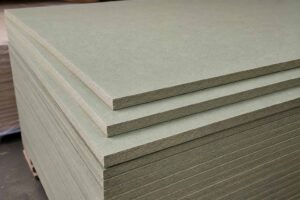
HDHMR is one of the fastest-growing materials in modern interiors.
It combines the smooth finish of MDF with improved moisture resistance.
Manufactured under higher pressure and density than MDF, HDHMR offers significantly better durability.
Advantages
- Better moisture resistance than MDF
- Smooth surface
- Strong screw holding
- Ideal for modular furniture
- Excellent machining quality
- More durable
Limitations
- More expensive than MDF
- Still not completely waterproof
- Slightly heavier
HDHMR has become increasingly popular for wardrobes, kitchens, and modular furniture.
4. WPC (Wood Plastic Composite)
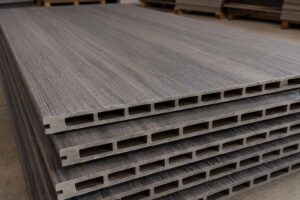
WPC is completely different from the previous materials.
Instead of wood fibers alone, it combines wood powder with thermoplastics.
The result is a board that is virtually waterproof.
Advantages
- 100% waterproof
- Termite proof
- Rot resistant
- Fungus resistant
- Suitable for wet areas
- Low maintenance
Limitations
- Higher cost
- Heavier
- Limited premium finishes
- Lower rigidity in large spans
- Expansion under heat
Because of its waterproof nature, WPC is ideal for bathrooms, wash areas, and utility spaces.
Kerala’s Climate Makes Material Choice Critical
One mistake many homeowners make is assuming every engineered board behaves the same.
In reality, Kerala’s humidity exposes their differences very quickly.
For example:
A wardrobe near a bathroom experiences moisture daily.
A modular kitchen is exposed to:
- Steam
- Water spills
- Oil vapour
- Heat
Meanwhile, a TV unit inside an air-conditioned living room remains mostly dry.
Using the same board in all these places is rarely the best decision.
Professional designers instead match materials to the environment.
Which Material Lasts the Longest?
Durability depends on both the material and where it’s used.
Generally:
- Marine plywood can easily last over two decades with proper installation.
- HDHMR offers excellent durability for most indoor applications.
- WPC can last for decades in wet environments because it doesn’t absorb water.
- MDF performs well only in dry spaces.
The best material is not necessarily the strongest one.
It’s the one best suited to its environment.
Moisture Resistance Comparison
If your home is located in coastal Kerala or near rivers, moisture becomes the biggest concern.
Here’s how the materials compare from lowest to highest moisture resistance:
MDF → HDHMR → Marine Plywood → WPC
This is why experienced interior professionals rarely recommend MDF for kitchens in Kerala.
Which Material is Best for Modular Kitchens?
A modular kitchen faces constant exposure to:
- Water
- Steam
- Heat
- Cleaning chemicals
For cabinet boxes, marine plywood remains one of the safest choices.
HDHMR is also becoming popular because it offers good moisture resistance along with a smoother finish.
For sink cabinets or areas that regularly get wet, WPC offers unmatched protection.
Which Material is Best for Wardrobes?
Bedrooms are usually dry spaces.
Therefore:
- HDHMR provides an excellent balance of finish and durability.
- Plywood is preferred for premium wardrobes.
- MDF works only for decorative shutters in moisture-free environments.
Which Material Should You Avoid in Bathrooms?
Bathrooms experience constant humidity.
Avoid:
- MDF
- Standard particle boards
Instead choose:
- WPC
- Marine plywood with proper waterproof laminates
These materials perform much better over time.
Cost vs Value
Many homeowners focus only on the initial cost.
However, replacing swollen cabinets after five years costs far more than investing in better materials from the beginning.
A slightly higher upfront investment often results in:
- Lower maintenance
- Better appearance
- Longer lifespan
- Higher resale value
When planning interiors, always consider lifetime value rather than purchase price alone.
Common Myths About Interior Materials
Myth 1: MDF is the worst material.
Not true.
MDF performs exceptionally well for decorative panels, painted furniture, and dry interiors.
Its limitations appear mainly in moisture-prone environments.
Myth 2: WPC is always better than plywood.
Also false.
Although WPC is waterproof, plywood is often stronger for large furniture structures and heavy load-bearing applications.
Myth 3: All plywood is waterproof.
Incorrect.
Only marine-grade plywood offers high water resistance.
Lower grades like MR plywood are not designed for prolonged moisture exposure.
Myth 4: Expensive always means better.
Not necessarily.
Choosing the right material for the right location matters far more than buying the most expensive board.
Expert Recommendation for Kerala Homes
If you’re building a home in Kerala in 2026, a smart combination of materials often delivers the best results.
A practical approach is:
- Marine plywood for kitchen cabinets and heavy-duty furniture.
- HDHMR for wardrobes, TV units, and bedroom furniture.
- WPC for bathrooms, sink cabinets, and utility areas.
- MDF for decorative wall panels, painted shutters, and CNC designs in dry rooms.
This balanced approach offers durability, aesthetics, and better value for money.
Final Thoughts